


SCRABBLE MILK CHOCOLATE EDITION tiles trophy crossword game board limited rare
Specifications
| All Returns Accepted | ReturnsNotAccepted |
| Expiration Date | Best By Date: 12-28-18 |
| MPN | does not apply |
| Country/Region Of Manufacture | Canada |
| Product | Novelty Chocolate |
| Packaging | Box |
| Brand | Hasbro |
| Recommended Age Range | 10+ |
| Best By Date (Not Expiration Date) | December 28, 2018 |
| Year | 2017 |
| Age Level | 10 Years and Up |
| Material | Milk Chocolate |
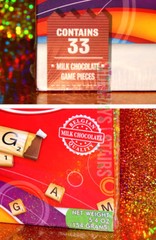
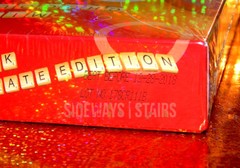
Check out our other new & used items>>>>>HERE! (click me) FOR SALE:A wonderful word game in collectible, Belgium chocolate formSCRABBLE CROSSWORD GAME - MILK CHOCOLATE EDITION DETAILS:Play, win, and enjoy!Each Belgium milk chocolate Scrabble tile is individually wrapped and has a different letter on each side of the wrapper. Box back includes gameplay rules. Front of box states 33 chocolate game pieces - we believe the golden trophy is the 33rd chocolate piece. Game board is made of paperboard. What's included:32 Chocolates1 Playing Board 1 Golden Trophy Best By Date (not expiration date): "12-28-18"A best by date differs from an expiration date as it notes when the product is guaranteed to taste its best until, not when you should no longer eat it. Though this Milk Chocolate Edition of Scrabble has reached its Best By Date it may still taste fine, however it is being sold as a collectible and we do not recommend eating the product. Makes a great gift for Scrabble fanatics, especially those who enjoy collectibles and novelties! CONDITION:New; sealed. Shrink wrap may have a small tear. Please see photos. THANK YOU FOR LOOKING. QUESTIONS? JUST ASK.*ALL PHOTOS AND TEXT ARE INTELLECTUAL PROPERTY OF SIDEWAYS STAIRS CO. ALL RIGHTS RESERVED.* "Scrabble is a word game in which two to four players score points by placing tiles bearing a single letter onto a board divided into a 15×15 grid of squares. The tiles must form words that, in crossword fashion, read left to right in rows or downward in columns, and be included in a standard dictionary or lexicon. The name is a trademark of Hasbro, Inc. in the United States and Canada; outside these two countries it is a trademark of Mattel. The game is sold in 121 countries and is available in 29 languages; approximately 150 million sets have been sold worldwide and roughly one-third of American and half of British homes have a Scrabble set.[1][2][3][4] There are around 4,000 Scrabble clubs around the world.... The game is played by two to four players on a square board with a 15×15 grid of cells (individually known as "squares"), each of which accommodates a single letter tile. In official club and tournament games, play is between two players or, occasionally, between two teams each of which collaborates on a single rack.[5] The board is marked with "premium" squares, which multiply the number of points awarded: eight dark red "triple-word" squares, 17 pale red "double-word" squares, of which one, the center square (H8), is marked with a star or other symbol; 12 dark blue "triple-letter" squares, and 24 pale blue "double-letter" squares. In 2008, Hasbro changed the colors of the premium squares to orange for TW, red for DW, blue for DL, and green for TL, but the original premium square color scheme is still preferred for Scrabble boards used in tournaments.[6] In an English-language set, the game contains 100 tiles, 98 of which are marked with a letter and a point value ranging from 1 to 10. The number of points for each lettered tile is based on the letter's frequency in standard English; commonly used letters such as vowels are worth one point, while less common letters score higher, with Q and Z each worth 10 points. The game also has two blank tiles that are unmarked and carry no point value. The blank tiles can be used as substitutes for any letter; once laid on the board, however, the choice is fixed. Other language sets use different letter set distributions with different point values. Tiles are usually made of wood or plastic and are 19 by 19 millimetres (0.75 in × 0.75 in) square and 4 mm (0.16 in) thick, making them slightly smaller than the squares on the board. Only the rosewood tiles of the deluxe edition varies the width up to 2 mm (0.08 in) for different letters. Travelling versions of the game often have smaller tiles (e.g. 13 mm × 13 mm (0.51 in × 0.51 in)); sometimes they are magnetic to keep them in place. The capital letter is printed in black at the centre of the tile face and the letter's point value printed in a smaller font at the bottom right corner. S is one of the most valuable tiles in English-language Scrabble because it can be appended to many words to pluralize them (or in the case of most verbs, convert them to the third person singular present tense, as in the word PLUMMETS); Alfred Butts included only four S tiles to avoid making the game "too easy". Q is considered the most troublesome letter, as almost all words with it also contain U; a similar problem occurs in other languages like French, Dutch, Italian and German. J is also difficult to play due to its low frequency and a scarcity of words having it at the end.[7] C and V may be troublesome in the endgame, since no two-letter words with them exist, save for CH in the Collins Scrabble Words lexicon.... In 1938, American architect Alfred Mosher Butts created the game as a variation on an earlier word game he invented called Lexiko. The two games had the same set of letter tiles, whose distributions and point values Butts worked out by performing a frequency analysis of letters from various sources, including The New York Times. The new game, which he called "Criss-Crosswords," added the 15×15 gameboard and the crossword-style game play. He manufactured a few sets himself, but was not successful in selling the game to any major game manufacturers of the day.[9]:98 In 1948, James Brunot,[10] a resident of Newtown, Connecticut and one of the few owners of the original Criss-Crosswords game, bought the rights to manufacture the game in exchange for granting Butts a royalty on every unit sold. Though he left most of the game (including the distribution of letters) unchanged, Brunot slightly rearranged the "premium" squares of the board and simplified the rules; he also changed the name of the game to "Scrabble", a real word which means "to scratch frantically".[9]:100 In 1949, Brunot and his family made sets in a converted former schoolhouse in Dodgingtown, a section of Newtown. They made 2,400 sets that year, but lost money.[11] According to legend, Scrabble's big break came in 1952 when Jack Straus, president of Macy's, played the game on vacation. Upon returning from vacation, he was surprised to find that his store did not carry the game. He placed a large order and within a year, "everyone had to have one."[9]:101 In 1952, unable to meet demand himself, Brunot sold manufacturing rights to Long Island-based Selchow and Righter, one of the manufacturers who, like Parker Brothers and Milton Bradley Company, had previously rejected the game. In its second year as a Selchow and Righter-built product, nearly four million sets were sold.[12][9]:104 Selchow and Righter bought the trademark to the game in 1972.[13] JW Spears began selling the game in Australia and the UK on January 19, 1955. The company is now a subsidiary of Mattel.[9] In 1986, Selchow and Righter was sold to Coleco, which soon after went bankrupt. Hasbro purchased the company's assets, including Scrabble and Parcheesi.[13] In 1984, Scrabble was turned into a daytime game show on NBC. Scrabble ran from July 1984 to March 1990,[14] with a second run from January to June 1993. The show was hosted by Chuck Woolery. Its tagline in promotional broadcasts was "Every man dies; not every man truly Scrabbles."[15] In 2011, a new TV variation of Scrabble, called Scrabble Showdown, aired on The Hub cable channel, which is a joint venture of Discovery Communications, Inc. and Hasbro. Scrabble was inducted into the National Toy Hall of Fame in 2004." (wikipedia.org) "Word games (also called word game puzzles) are spoken or board games often designed to test ability with language or to explore its properties. Word games are generally used as a source of entertainment, but can additionally serve an educational purpose. Young children can enjoy playing games such as Hangman, while naturally developing important language skills like spelling. While Hangman is a seriously dark game, what we like to focus on is the development of the children. Researchers have found that adults who regularly solved crossword puzzles, which require familiarity with a larger vocabulary, had better brain function later in life.[1] Popular word-based game shows have been a part of television and radio throughout broadcast history, including Spelling Bee (the first televised game show) and Wheel of Fortune (the longest-running syndicated game show in the United States)." (wikipedia.org)
Related Items